Apr
27
2013
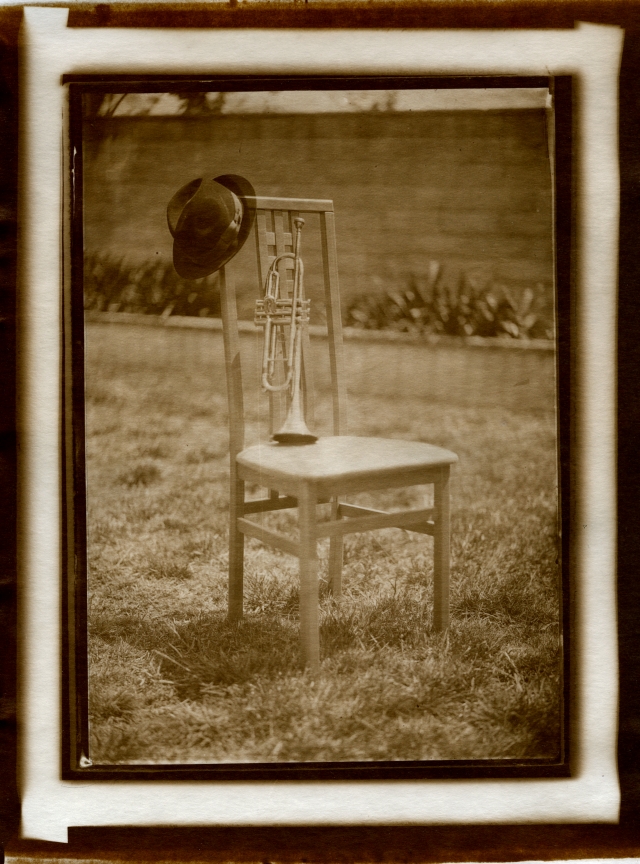
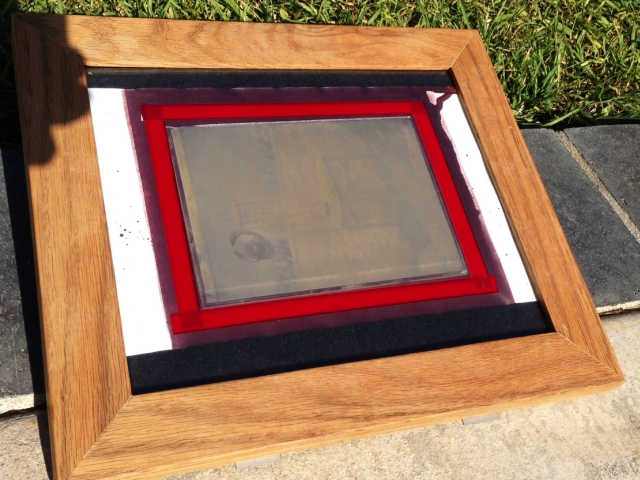
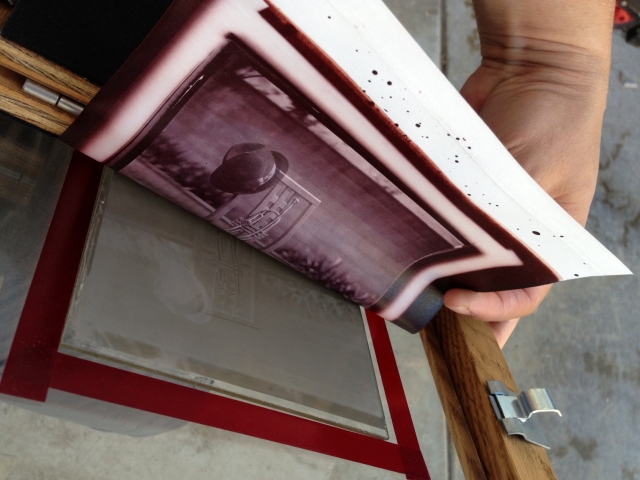
I finally did it – my first albumen print from my first glass negative. Many thanks to Monsieur Louis Désiré Blanquart-Evrard. For the longest time I’ve struggled to control the fogging brought on by long exposures and long development. I did not want to do intensification or re-development. It’s quite a balance between exposure and development to get a dense negative.
The Print


Negative density range: 2.14 – 0.64 = 1.50
Albumen: 1.5% sodium chloride with vinegar
Paper: 9×11 Canson Universal Sketch (aka. Crob ‘Art) single coated (float method)
Sensitization: 12% silver nitrate, rod method
Exposure: 5 minutes next time I’ll fire up the NuArc.
I bought a few turn of the century glass negatives from E-bay – we’ll see how those turn out next!
no comments | tags: Snaps | posted in 5x7, Alternative Process, Still Life
Mar
22
2011

I still can not get smooth skies on Carbon. I think it’s moisture in the tissue evaporating while under UV. Maybe I’ll throw a fan on it next time.
no comments | tags: Snaps | posted in 4x5, Alternative Process, Carbon Printing
Jan
20
2011
My Bristlecone pine image on carbon was sent to Australia. I especially wanted it to be memorable to the person receiving my print since he’s a does a lot of alternative processing like I do. He told me he wanted to learn carbon printing and now he has something to look forward to.

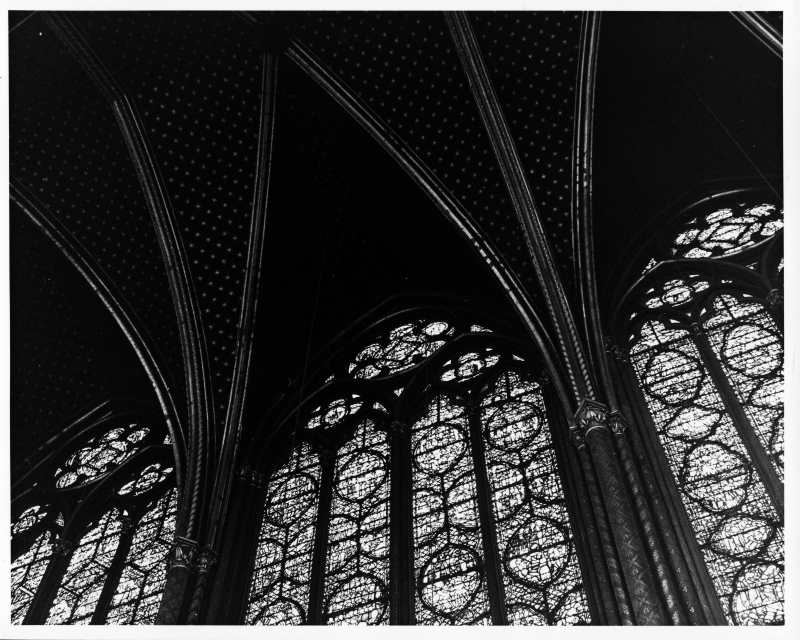
Today, I finally receive my print from my “blind” trader. It was due in the end of November but apparently the person got a little busy. It’s an image of the ceiling from Sainte-Chappelle chapel from Paris, France and taken with a 50′s Yashica 635 TLR . It’s printed on Kentmere VC Select resin coated paper.
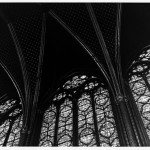
Not bad, well worth the wait I think.
no comments | tags: Snaps | posted in Alternative Process, Analog, APUG, Carbon Printing
Dec
28
2010
I took up carbon printing this past summer with Jim Fitzgerald in Ventura, CA – he’s a fabulous teacher. He couldn’t afford materials to support traditional photography so his search lead him to learn Carbon Printing (the real one, not the ink jet version). The materials are really inexpensive (dirt cheap) but the process takes 3-4 days and the permanence rivals that of a platinum/palladium print. The best part about a carbon print is the relief it gives between shadows and highlights. One must really hold a carbon print against the light to understand.
I made my first batch of “glop” and I was surprise how easy it is to make – almost like cooking. However, my printing process still needs some refinement. In particular, I need to fine tune my contrast control and patience control.

I was a little too eager on my first print and agitated it too much. The edges started to frill but I kinda’ like the effect it gave!
no comments | tags: Snaps | posted in Alternative Process, Carbon Printing
Aug
8
2010
Hand-coating printing is becoming an obsession for me. Today I made my first cyanotype print, a process formulated in 1842 by Sir John Herschel, though it was first applied to photography by the English botanist Anna Atkins.
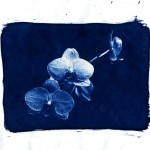
This print was made using Bostick-Sullivan’s kit and since I do not have a UV light box it’s officially a sun print – 10 minutes under the sun and a 15 minute dunk in tap water. I kinda’ enjoy UV printing with cyanotype since no dark room is needed, cheap emulsion, permanent, and very little chemicals to deal with. Incidentally, this is also my first contact print from my new “old” 1922 Korona 5×7 camera.
Flickr has a group dedicated to this process and if you want to learn more check out the process at Alternative Photography website.
no comments | tags: Snaps | posted in Alternative Process, Cyanotype, Large Format