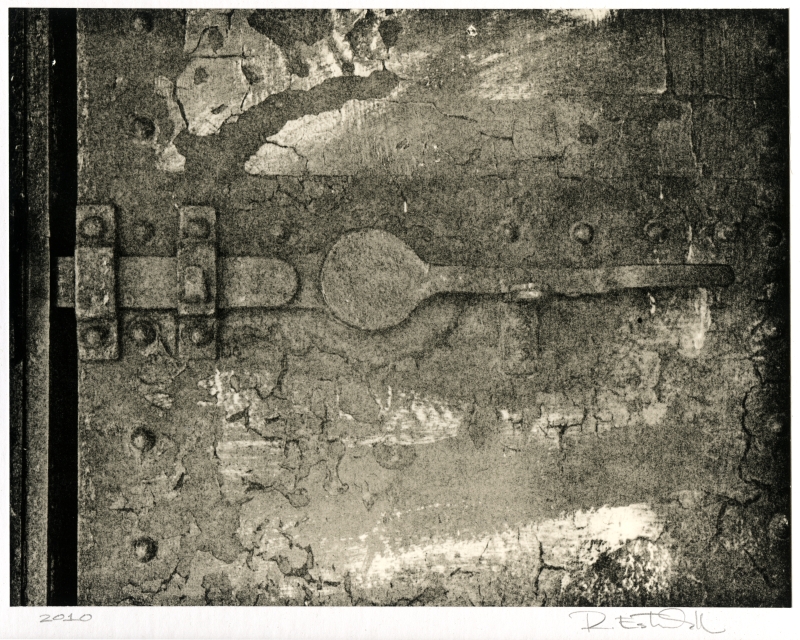
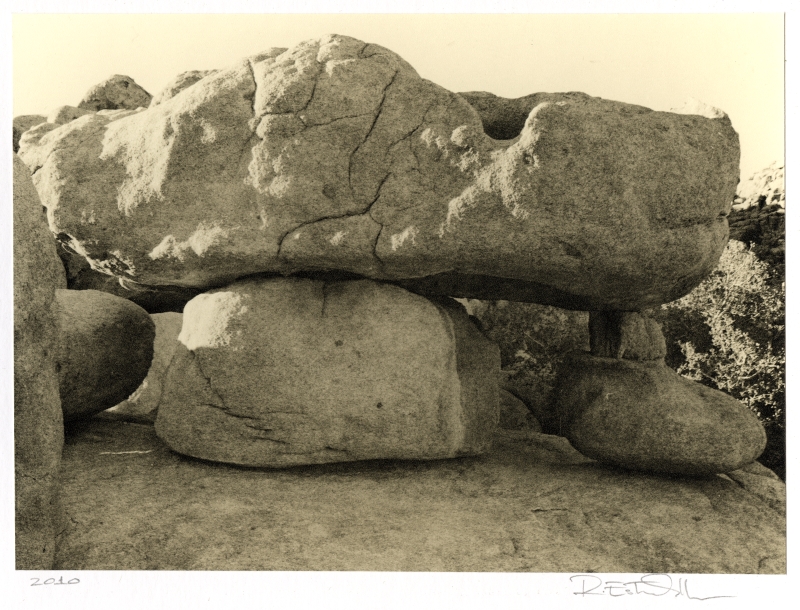
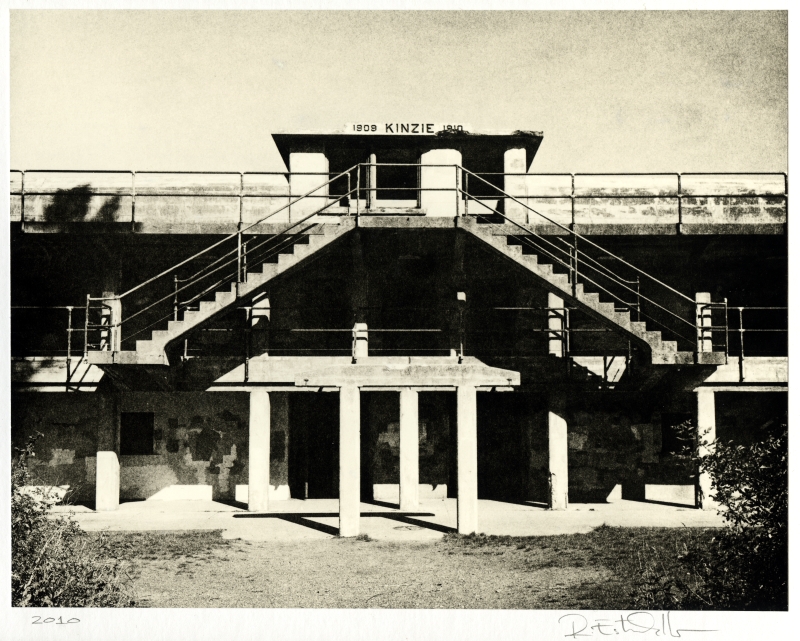
Well, another assignment from BPX – this print is going to Toronto, Canada. The shot of Pete’s car in Death Valley was taken in January (Pete was a persistent guy).
I used my 1922 Korona with my home made 5×7 to 4×5 reducing back, Kodak TXP 320 film and Nikkor 180mm lens. I had a few sheets of Arista Edu 8×10 glossy fiber paper left and developed it in dektol then sepia toned. I’m beggining to be comfotable in mounting prints and have no qualms about mounted silver gelatin longevity.
I’m curious what I’ll get from the exchange this time around.
Early January morning at Zabriskie. I wasn’t blessed with dramatic clouds at Manly Beacon but I was gifted with this instead. Death Valley is a fantastic place.
With the rise of digital cameras and inkjet technologies – I applaude Ilford for coming out with a new black and white fiber base paper. Simon Galley, Company Director for Ilford and an APUG subscriber, indicated that the paper will be released internationally on March. It has been available in Europe and Moersch Wolfgang has tested it on his lith developer and posted some samples on Flickr. Reports have been positive.
Ilford continues to be dedicated in the support of analog photography with new silve-based materials. I can’t wait to try these out!
Well I’m enjoying blind print exchanges so much I decided to participate in the Lith Print exchange as well. Of course, I have no idea where to start so I bought Dr. Tim Rudman’s definitive book on the process. He made it so easy to understand and allowed me to make a few decent prints.
Three prints will be going to Ukraine, Canada, and Moscow – I will also receive one from each place. I do hope my prints will be good enough for them.
My Bristlecone pine image on carbon was sent to Australia. I especially wanted it to be memorable to the person receiving my print since he’s a does a lot of alternative processing like I do. He told me he wanted to learn carbon printing and now he has something to look forward to.
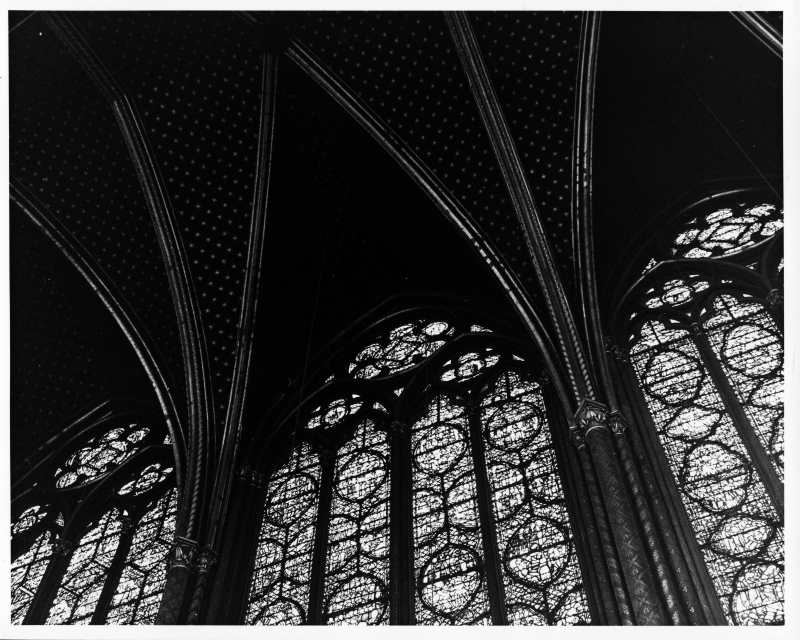
Today, I finally receive my print from my “blind” trader. It was due in the end of November but apparently the person got a little busy. It’s an image of the ceiling from Sainte-Chappelle chapel from Paris, France and taken with a 50′s Yashica 635 TLR . It’s printed on Kentmere VC Select resin coated paper.
This story is so amazing and inspirational. She was a giant of photography and a significant discovery.
John Maloof found over 100,000 of her negatives in an antique auction with some rolls still un-developed! He then scanned and posted it on a photography site. The response he received was just outstanding – no surprise as Vivian’s photos are amazing.
I took up carbon printing this past summer with Jim Fitzgerald in Ventura, CA – he’s a fabulous teacher. He couldn’t afford materials to support traditional photography so his search lead him to learn Carbon Printing (the real one, not the ink jet version). The materials are really inexpensive (dirt cheap) but the process takes 3-4 days and the permanence rivals that of a platinum/palladium print. The best part about a carbon print is the relief it gives between shadows and highlights. One must really hold a carbon print against the light to understand.
I made my first batch of “glop” and I was surprise how easy it is to make – almost like cooking. However, my printing process still needs some refinement. In particular, I need to fine tune my contrast control and patience control.
I was a little too eager on my first print and agitated it too much. The edges started to frill but I kinda’ like the effect it gave!
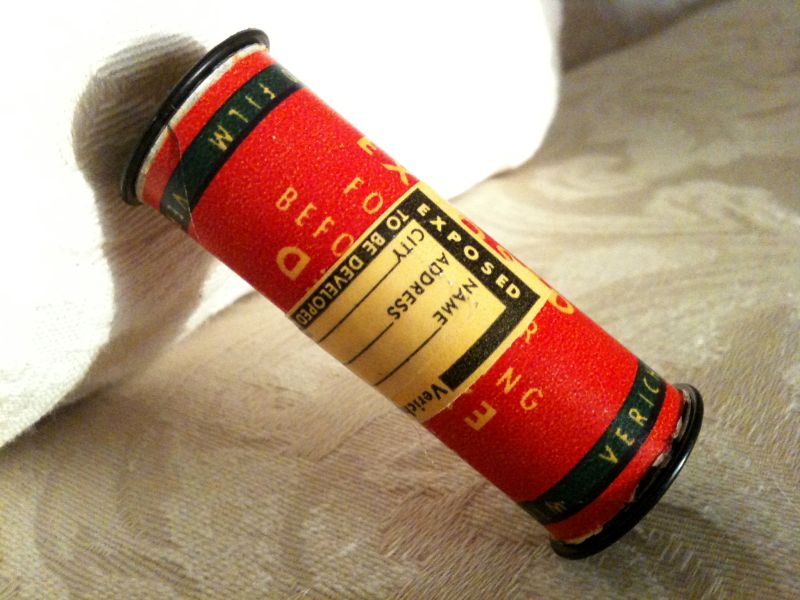
One of the joy in shooting film is that you don’t know what you’ll get ’til you develop it. Well, a couple of years ago I bought a vintage Perkeo II (pygmy in German since it so small) and it still had a Kodak film in it. Thinking nothing of it, I rolled it up and threw the film in my desk drawer – out of sight and out of mind.
Yesterday, I was looking for a paper clip and when I opened the drawer I thought maybe I should look more into this film. It turns out to be a real old Verichrome Pan film and I suspect it was from the late 50′s since that’s when it was made available.
I wasn’t really optimistic about it but I’d still want to do this carefully. I scoured the internet for development times and what I should soup it in, I had Kodak’s D-76 developer in my darkroom and that was acceptable. I knew that over developing could easily fog this film and but I wanted to make sure that it would be enough. So instead of developing it at 68 degrees F for 10 minutes, I cooled the developer down a bit to 64 degrees F and should compensate for 30% more time. However, Since I was going to continuously agitate it I opted to increase the time by %15 to 11.5 minutes instead.
After rinsing the film, I pulled it out of the tank. The film was very soft and curled like crazy, both length wise and width wise. To my excitement I was able to salvage one frame in the middle of the roll. The rest of the film was severely fogged. I hanged it with two clips on the bottom to help flatten it whilst it dried.
Here’s a negative scan of it…
It appears to be a photo of a window looking out – I can barely make out the house across the street. Talk about anticipation, this image waited 40 years to be seen. Now that’s something you can’t feel when looking at an LCD on the back of a camera!
My OM-1n was recently killed in action. After about a year and half of service, including a tour of duty in Cancun, Mexico, the film cock (hehehe… I wrote “cock”) got stuck.
I will most likely have it repaired again but in the meantime, I think I will enjoy my father’s Canon AE-1. I had it CLA’d recently and it’s been working like a champ, though, I can’t use my OM lenses on it. However, I do have a 50mm F/1.4 and an M42 adapter so I can use my Pentax SMC Takumars on it.
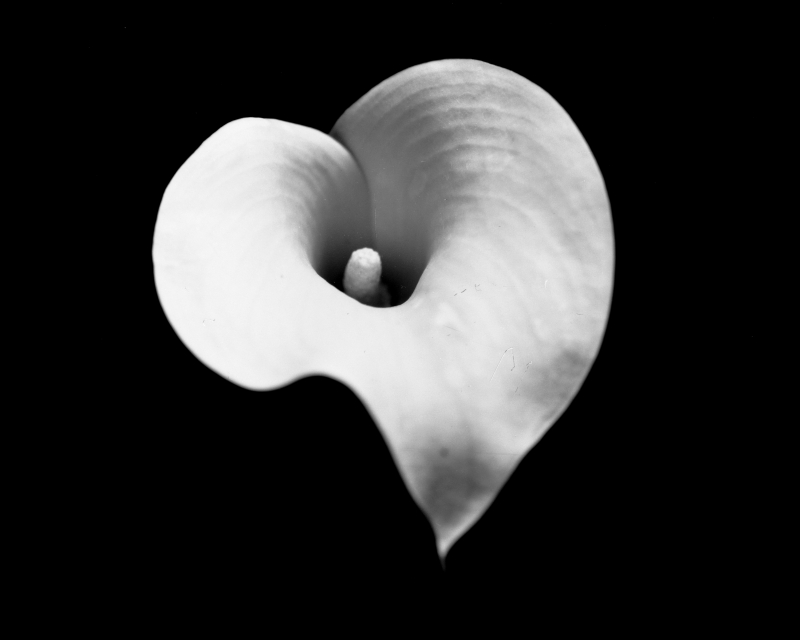
I’ve been meaning to take pictures of a cala lily (aka. “Z. elliottiana”) and Home Depot was on my way home from an errand; I was fortunate to find the yellow variety.
It gave me an opportunity to try the CSX green sensitive X-ray film rated at ISO 80. These were taken using the Zone VI 8×10 camera and Kodak CE 300mm, strobed with the 580EX II camera left at full power. I believe the shutter was set to 1/150 and the aperture was F16. I also shot it in 4×5 format with AEU100 film for silver gelatin enlargements.
Both images were film scanned but I intend to print a few of these in carbon and platinum-palladium once I find a few I like.
Hand-coating printing is becoming an obsession for me. Today I made my first cyanotype print, a process formulated in 1842 by Sir John Herschel, though it was first applied to photography by the English botanist Anna Atkins.
This print was made using Bostick-Sullivan’s kit and since I do not have a UV light box it’s officially a sun print – 10 minutes under the sun and a 15 minute dunk in tap water. I kinda’ enjoy UV printing with cyanotype since no dark room is needed, cheap emulsion, permanent, and very little chemicals to deal with. Incidentally, this is also my first contact print from my new “old” 1922 Korona 5×7 camera.
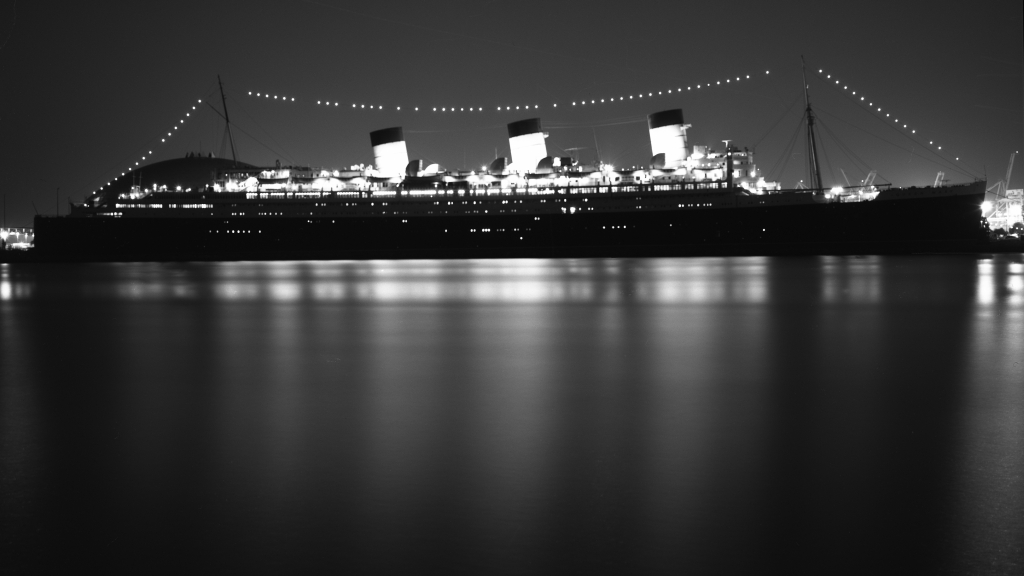
So we decided to head out to Long Beach and take a night time shot of the Queen Mary. It’s a good opportunity to try out my new “old” 1920′s 5×7 Korona large format camera with the 1951 Kodak Commercial Ektar 12 inch (~305mm) lens. Grabbed some film, tripod, shutter cable and my dark cloth – here’s a film scan of what I saw.
It turns out, the Kodak CE was too long from our vantage but luckily I brought the Schneider 240mm lens and the field of view barely covered from bow to stern.
I used Arista’s EDU Ultra 100 film (re-branded Fomapan 100, manufactured in Czech Republic) and it’s notorious for reciprocity failure at exposures greater than 1 second. Proper exposure at F16 during this time was 30 seconds so I cooked it for 10 minutes (a wild estimate).
Whenever a patrol boat or a cruise ship would cross by the shot I just covered the lens with the dark slide and compensated for more time, a benefit of long exposures. Once I got home, I souped it in Rodinal 1:50 for 8 minutes with the Jobo drum.
Next time I’m bringing the 75mm so that I can use my home made 5×7 to 4×5 reducing back.
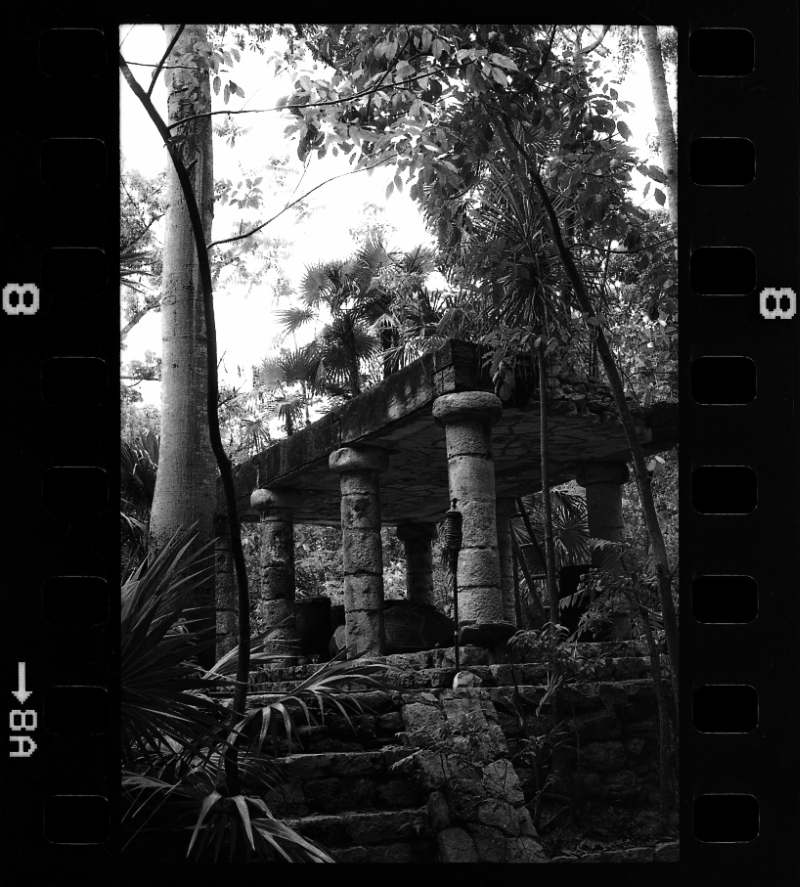
Sent out another print to Europe and I decided to print this image from Xcaret, Mexico. The glossy FB print needed some dodging to get more detail inside the structure.
This 35mm film is the Legacy Pro 400 (re-branded Fuji Neopan 400) I under exposed it by 2 stops giving an equivalent ISO rating of 1600. Stand developed it with Rodinal 1:100 for about an hour in the hotel room, making the bathroom a makeshift dark room at night. I didn’t want to bring it back home un-processed as TSA or Mexico’s airport security X-rays might fog it.
So far I’ve been getting prints from the exchange. I’ve read others are not so lucky, either its lost in the mail or their donor just don’t send one.
My adventure in platinotype printing has begun! I had the opportunity this weekend to receive a one on one Platinum/Palladium training with Per Volquartz and the results can be seen below.
The scan doesn’t do this justice – the tonality is incredible. It’s amazing that a print can be made without turning down the lights, though they are contact prints. As long as there are no UV light source, prints like these can be made. The platinum and palladium salts are expensive but the developer can never be exhausted. In fact, you can use soda pop to process these prints – Coke for developer and Sprite or 7-Up for clearing baths; it’s more expensive but in a pinch a quick run to the market is all you need.
My darkroom will still be open for silver gelatin prints but will reserve this method for the wall hangers.
This article is about the collision between pro photographers and amateur stock photographers, all because of digital cameras. I think it comes down to the following…
Film + Darkroom Work = Art Photography
Digital Camera + Photoshop Processing = Photojournalism
…at least more so now.
Painting is one of the hardest medium to learn but the easiest to identify with the artist. On the other, with photography it’s always been difficult to identify between the artists and their photography, yet it is the easiest medium to learn. Digital photography blurs that line further.